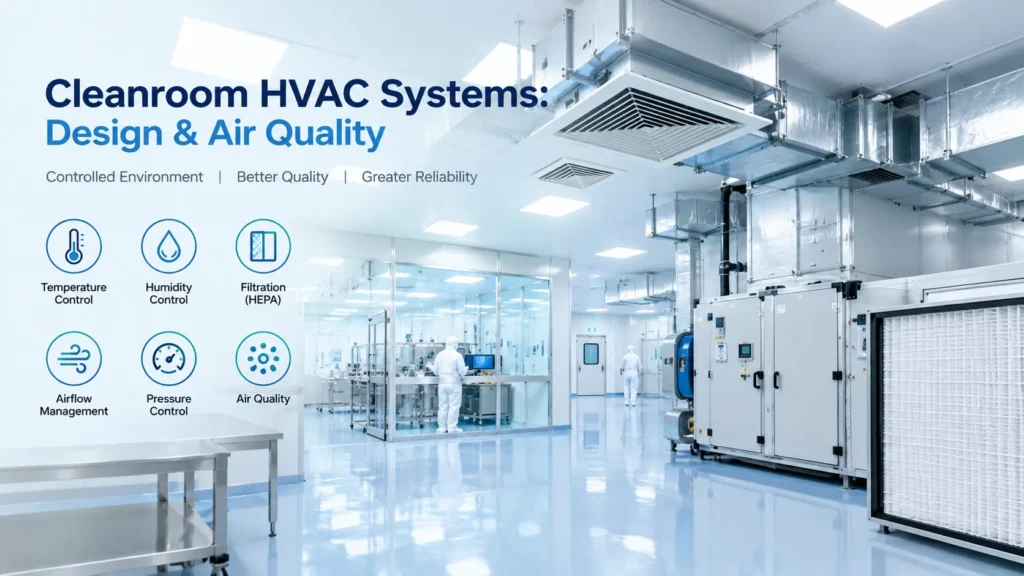
In a cleanroom, air conditioning is not simply about keeping people comfortable. The HVAC system plays a critical role in maintaining a controlled environment.
From pharmaceutical manufacturing and biotechnology laboratories to electronics, healthcare, food processing, and precision manufacturing, cleanrooms require careful control of airborne particles, temperature, humidity, pressure, and airflow.
Cleanroom HVAC systems help maintain these environmental conditions while supporting product quality, process consistency, and contamination control.
What Is a Cleanroom HVAC System?
A cleanroom HVAC system is a specialized heating, ventilation, and air-conditioning solution designed to maintain controlled environmental conditions within a clean space.
Depending on the application, it may control:
- Airborne particle concentration
- Room temperature and relative humidity
- Air pressure differentials
- Airflow direction and air-change rates
- Fresh-air supply and filtration efficiency
- Contamination transfer between adjoining spaces
These parameters work together. High-efficiency filters alone cannot guarantee cleanroom performance. Filtration must be coordinated with airflow, pressure control, room construction, and process requirements.
Why Is HVAC Design Important in Cleanrooms?
In a conventional office, small variations in temperature or airflow may primarily affect comfort. In a cleanroom, similar variations can potentially affect sensitive processes and product quality.
Industries such as pharmaceuticals, biotechnology, medical devices, electronics, semiconductor manufacturing, and laboratories may require carefully controlled environmental conditions.
A properly engineered cleanroom HVAC system considers heat generated by machinery, lighting, operators, production processes, and outdoor conditions while maintaining the required cleanliness and pressure relationships.
Key Cleanroom HVAC Design Requirements
Every cleanroom has different requirements depending on its intended use, cleanliness classification, equipment, occupancy, applicable standards, and operating conditions.
1. Air Filtration
Cleanroom HVAC systems commonly use HEPA filters as part of their air-filtration strategy. The appropriate filtration arrangement depends on the application and required cleanliness level.
Engineers must also consider filter location, air velocity, pressure drop, filter loading, replacement access, fan capacity, and air distribution.
Proper filtration design helps control airborne particles while supporting reliable operation and manageable maintenance.
Temperature Control in Cleanroom HVAC Systems
Temperature control supports both occupant comfort and process stability. Certain manufacturing processes, materials, laboratory procedures, and equipment can be sensitive to temperature variations.
A cleanroom HVAC design should account for heat loads from production equipment, operators, lighting, electrical systems, outdoor conditions, adjacent rooms, and process-generated heat.
Accurate heat-load calculations help prevent insufficient cooling and unnecessary oversizing. The objective is to maintain stable conditions within the project’s specified operating range.
Why Is Humidity Control Important?
Temperature and humidity are closely connected. Excessive humidity can create problems for certain processes and materials, while very low humidity may increase static electricity concerns in sensitive applications.
Cleanroom HVAC systems may therefore require dedicated humidification or dehumidification strategies. Requirements should be established according to the process, product, equipment, materials, and applicable standards.
Pressure Differential and Contamination Control
Cleanrooms often maintain pressure differences between adjoining spaces to influence the direction of airflow.
In many applications, cleaner areas are maintained at a higher pressure than surrounding spaces to help reduce the entry of less-controlled air.
However, positive pressure is not suitable for every environment. Certain laboratories, isolation areas, and processes involving hazardous materials may require negative pressure to help contain contaminants.
The pressure strategy must be designed according to the facility’s process and safety requirements.
What Is a Cleanroom Pressure Cascade?
A pressure cascade is a planned sequence of pressure relationships between rooms, corridors, airlocks, and surrounding areas.
A properly engineered pressure cascade helps control contamination movement and supports the intended cleanroom operating conditions.
Airflow Patterns in Cleanrooms
Airflow direction and distribution are as important as the amount of air supplied.
Unidirectional Airflow
Unidirectional airflow moves filtered air in a consistent direction across a controlled area. It is commonly associated with applications requiring high levels of contamination control.
Non-Unidirectional Airflow
Non-unidirectional or mixed airflow allows filtered supply air to mix with room air before returning to the HVAC system.
The appropriate approach depends on cleanliness requirements, room geometry, equipment layout, occupancy, and contamination sources.
Air Changes and Ventilation
Air changes per hour (ACH) describe how many equivalent room volumes of air are supplied or exchanged each hour.
The required airflow should be determined by the cleanliness requirement, contamination generation, airflow strategy, occupancy, room configuration, process, and applicable standards.
Simply increasing airflow does not automatically improve cleanroom performance. Excessive airflow can increase fan energy consumption, cooling requirements, filter loading, noise, and operating costs.
The objective is to provide the airflow needed for the required environmental performance.
How Can Cleanroom HVAC Energy Efficiency Be Improved?
Cleanroom HVAC systems can consume substantial energy because they may operate for extended periods while maintaining airflow, filtration, pressure relationships, cooling, and humidity control.
Depending on the project, efficiency measures may include:
- Energy-efficient fans and motors
- Variable-frequency drives (VFDs)
- Optimized air-change rates
- Efficient cooling equipment
- Proper duct sizing and insulation
- Low-pressure-drop system design
- Smart controls and Building Management System (BMS) integration
- Demand-based operating strategies where appropriate
Energy-saving measures should never compromise the environmental conditions required by the cleanroom.
For additional guidance, consult the U.S. Department of Energy’s guidance on energy-efficient electric chillers.
Monitoring and Control Systems
Modern cleanroom HVAC systems can incorporate sensors, controllers, alarms, and BMS integration to monitor operating conditions.
Depending on the facility, monitoring may include temperature, relative humidity, room pressure, filter differential pressure, equipment status, airflow conditions, and system alarms.
Reliable monitoring helps facility teams identify abnormal conditions and take corrective action.
Common Cleanroom HVAC Design Mistakes
Common design and operational issues include:
- Incorrect heat-load calculations
- Unsuitable airflow distribution
- Poor pressure balancing
- Inadequate humidity control
- Incorrect filter selection
- Poorly positioned supply and return air points
- Insufficient maintenance access
- Limited coordination between HVAC and cleanroom architecture
- Failure to consider future production requirements
A detailed understanding of the process and facility layout helps reduce these risks.
How Do You Choose the Right Cleanroom HVAC Partner?
Cleanroom HVAC projects require coordination across design, equipment selection, ducting, filtration, electrical systems, controls, installation, testing, balancing, commissioning, and maintenance.
Before choosing an HVAC partner, evaluate its understanding of heat-load calculations, airflow engineering, filtration, temperature and humidity control, pressure management, controls, commissioning, and preventive maintenance.
The lowest initial quotation may not always provide the lowest lifecycle cost. System performance, reliability, maintainability, energy efficiency, and long-term operating requirements should all be considered.
Cleanroom HVAC Solutions from Siddhivinayak Engineering (SVESPL)
Cleanroom HVAC is more than a standard air-conditioning requirement. It is an integral part of maintaining a controlled environment.
Siddhivinayak Engineering (SVESPL) provides HVAC engineering solutions for commercial, industrial, cleanroom, and specialized applications. Cleanroom project planning should consider cooling loads, airflow, filtration, ventilation, pressure relationships, temperature control, humidity management, and system integration.
Explore our HVAC services or contact our team to discuss your facility’s requirements.
Frequently Asked Questions About Cleanroom HVAC Systems
What is the main purpose of a cleanroom HVAC system?
Its main purpose is to maintain the environmental conditions required by a cleanroom, including temperature, humidity, filtration, airflow, pressure, and airborne particle control.
Do cleanrooms require HEPA filters?
Many cleanrooms use HEPA filters as part of their filtration strategy. The required filtration level and configuration depend on the application and cleanliness requirements.
Why is pressure control important in a cleanroom?
Pressure differences help influence airflow between adjoining spaces and can reduce contamination transfer. The correct pressure strategy depends on whether the process requires contamination exclusion or containment.
What is the role of humidity control in cleanrooms?
Humidity control helps maintain suitable environmental conditions for sensitive products, materials, equipment, and processes. Requirements vary by application.
How can cleanroom HVAC energy consumption be reduced?
Potential measures include efficient fans and motors, optimized airflow, suitable variable-speed controls, efficient cooling equipment, proper maintenance, and monitoring. These measures must preserve required environmental conditions.
What factors determine cleanroom HVAC design?
Key factors include cleanliness classification, process requirements, heat loads, occupancy, airflow patterns, filtration, pressure relationships, humidity requirements, applicable standards, and operating schedules.
Can SVESPL help with cleanroom HVAC projects?
Contact Siddhivinayak Engineering (SVESPL) through its HVAC services page or contact page to discuss your project requirements.
Conclusion
A reliable cleanroom HVAC system helps maintain the controlled conditions required in sensitive commercial and industrial environments. Its design must consider temperature, humidity, filtration, airflow, pressure differentials, and overall air quality.
The right solution depends on the cleanroom classification, process requirements, equipment heat loads, operating hours, and applicable standards. Careful engineering, suitable equipment selection, reliable controls, and professional commissioning can support environmental stability, contamination control, energy efficiency, and long-term performance.
If you are planning a new cleanroom, expanding an existing facility, or upgrading an HVAC system, contact SVESPL to discuss your engineering requirements. Explore more HVAC Contractor in Pune for Commercial & Industrial Projects
About The Author
